Hi, I'm Rose Baes, and I'm a registered pharmacist.
Today I will share with you the steps that I did in order to get my pharmacist license
here in the US after graduating from a foreign school, specifically [in] the Philippines.
The reason I'm posting this video is because ever since I took the FPGEE in 2010, I've
been getting a lot of Facebook messages asking about the exam, how I studied, what the process
actually looks like, and so on.
And even though I don't mind getting those messages in my inbox, I just thought it would
be a good idea to post a YouTube video as well to, just to give you like a general visual
picture of the whole process, because I think that just like anything else in life, any
goal seems to be more achievable when you have the whole process [leading to it] laid out before you,
just like this!
I originally graduated in 2009 with a [4-year] BS Pharmacy degree, and since that wasn't
enough to fulfill the NABP requirements, I studied for another year, so in 2010 I graduated
again.
I took the pharmacy board exam, got my license there, and in that same year I migrated here
to the United States.
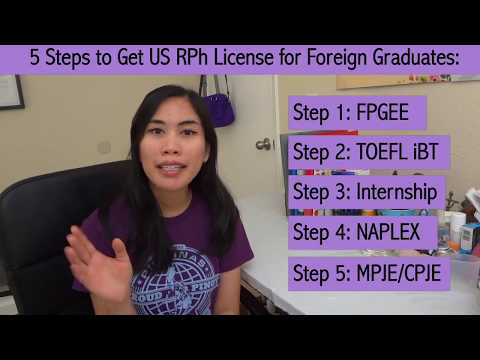
Okay, so basically there are 5 steps that you need to do to get your pharmacist license
here in the US if you're a foreign graduate.
Step number 1 is to take the FPGEE, step number 2 is to take the TOEFL iBT, step number 3
is to do your internship, step number 4 is to take the NAPLEX, and step number 5 [is
to] take the MPJE or the CPJE if you're in California.
Keep in mind that some of these steps are actually interchangeable, like for example
the FPGEE and the TOEFL can actually be taken in any particular order, so the TOEFL could
be your Step 1 and the FPGEE, Step 2.
And then also the NAPLEX and the MPJE could be reversed as well.
STEP 1: Take the FPGEE.
FPGEE stands for Foreign Pharmacy Graduate Equivalency Exam.
So what it is exactly is kind of like a board exam except that it doesn't give you a pharmacist
license.
It's basically just a proof that your pharmacy education is equivalent to that of a pharmacist
that's educated here in the US.
So it has 250 questions, and when I took this in 2010, it only had multiple choice questions
all throughout the test, but now they have since modified the test to include several
formats like multiple answer format, hotspot format, and ordered response.
So it's administered twice a year, once in the spring which is around April-May, and
once again in the fall which is around September or October.
It's offered anywhere in the continental United States.
STEP 2: Take the TOEFL iBT
TOEFL stands for Test of English as Foreign Language Internet-Based Test.
So this test is basically just a test of English but it's quite challenging because it has
a Speaking part.
The test is technically divided into 4 components.
It has Reading, Listening, Speaking, and Writing.
Each component is worth 30 points, and for you to be considered by the NABP, you have
to score at least 22 in Reading, 21 in Listening, 26 in Speaking, and 24 in Writing.
One important thing to know is that the TOEFL is administered all over the world but for the
NABP to accept your scores, you can only take it in the US, US territories, Australia, New
Zealand, and most of Canada.
So you cannot take it in the Philippines or the NABP will not accept your score.
STEP 3: Complete the State-Required Internship.
At this point, you would have to have a visa that's permitted for employment because
internship is considered "work."
And you can't work on just a tourist or a visitor's visa.
Every state is different when it comes to their internship requirements but for most
of America it's 1500 hours.
I know that in Washington State, the number of hours corresponds to your score on the
FPGEE.
So the higher the score, the smaller the hours that you need to complete.
And also in the state of New York, it's a whole different kind of story because there
you will need to take the NAPLEX first before you can do the internship.
But in California where I practice, it's 1500 hours which roughly equates to about
10 months if you're going to be working full-time or 40 hours a week.
So an intern pharmacist can basically do anything that a licensed pharmacist can do except final
check.
These include patient counseling, administering flu shots and other vaccinations, communicating
with prescribers about a prescription, and the list goes on.
In California they require you to do part of your 1500 hours of internship in a community
setting such as a retail chain pharmacy, and another part in an institutional setting like
a hospital pharmacy, sterile compounding pharmacy, or a long term care pharmacy.
And then once you've completed your hours you can now apply for the NAPLEX and the CPJE
or MPJE.
STEP 4: Take the NAPLEX
Effective November 2016, the NAPLEX has increased the number of questions from 185 to 250 and
the questions are in the same format as the FPGEE.
One of the main differences between the NAPLEX and the FPGEE is that the NAPLEX is more clinically
based and also the questions are more scenario-based, like you will see most of the questions presented
in a patient scenario format with a patient profile alongside their medical history and
several questions following it.
Then you will have to use your clinical judgment to answer the questions properly.
The highest scaled score you can get is 150 and the passing score is 75.
STEP 5: Take the MPJE or the CPJE (if you're in California)
So what this is basically is the pharmacy law and regulations part of the board exam.
If you're going to be taking the MPJE, it's going to be 120 questions long, and the passing
score is 75.
The highest is 100.
If you're in California, the test is going to be called CPJE and it's a 90-item exam,
all multiple choice throughout, and the highest score you can get is 99 and the passing score
is 75.
Once you have passed both the NAPLEX and the MPJE or CPJE, you can now apply for your RPh
license.
Yay!
Okay, so that ends my 5 steps of how I got my pharmacist license here in the US.
Thank you so much for watching and thank you for making it to the end of this video.
I hope I didn't bore you out too much.
Thank you again and good luck!


 For more infomation >> [FMV] yoonmin ; they don't know about us - Duration: 2:24.
 For more infomation >> 'So Far So Good': First U.S. Patient To Get New ALS Drug Doing Well Six Months Later - Duration: 2:37.
  For more infomation >> US economy adds 200K jobs in January - Duration: 1:56.


 For more infomation >> President Trump Just Kicked Snoop Out After He Denounced The U.S. - Won't Like Where He Sent Him! - Duration: 5:39.


Không có nhận xét nào:
Đăng nhận xét