Thank you for your question.
You submitted a question without a photo but you described in pretty good detail about
your concerns. Essentially, you've had a transplant done 11 months ago. And you're
asking, should you continue taking finasteride 1 milligram once a day. Your doctor recommends
it. And you state that your friends have noticed that your hair appears to be getting weaker
and you're concerned about the sexual side-effects and you want some guidance. Well, I can certainly
give you some information about how I approach this situation in my practice.
A little bit of background, I'm a Board-certified cosmetic surgeon and Fellowship-trained oculofacial
plastic and reconstructive surgeon. I have been in practice in Manhattan and Long Island
for over 20 years and treating hair loss has been a big part of my practice for years.
In fact, I'm the founder of TrichoStem™ Hair Regeneration Centers. This is a system
of treating hair loss non-surgically using a combination of Acellular matrix and platelet-rich
plasma. I'll discuss more in detail later but it evolved from our challenges in hair
transplant surgery.
So to begin with, you can see that there's a clear difference in how people are perceiving
the benefits and potential risks and side-effects of finasteride versus the medical doctor who
performed your surgery recommending that you take it. So just to put things in perspective,
finasteride is a drug that was originally marketed with the trade name Propecia starting
around 1997 and it's a drug that's been around for now going on 20 years. There was
always some degree of issues and concerns about short-term sexual side-effects and never
that much pursuit of significant research and evidence to look into the causes. Essentially,
clinical practice of medicine is listening to patient's history. And drug manufacturers
would often list side-effects based on the feedback they get from doctors.
So essentially, this drug has been a successful drug for a lot of men who were able to sustainably
take this drug for 10-20 years. And we have patients in our practice who have been on
this drug for that long and they continuously come in to have an evaluation and they renew
their prescription. So I would say that the probability is still favorable that you won't
have any long-term sexual side-effects. And right now, there's just a lot of amplifications
of fears such that many people are just unwilling to take the drug.
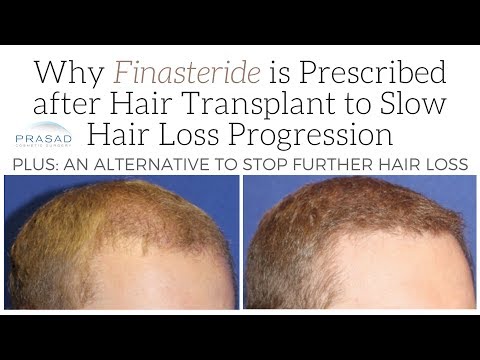
Now when you do a procedure like hair transplant, it is so important to do something to stabilize
your hair loss. And this is one of those challenges that if you take the drug finasteride away
from the equation, you're going to struggle with continuous progression at a faster rate.
Finasteride doesn't necessarily stop the progression but it does slow it down for men
who are successfully responding to the drug.
So I think you need to take all these in clinical context and ask your doctor about their experience.
Doctors who perform transplant surgery routinely prescribe this drug because essentially, it's
in the best interest of the patient to not lose more hair so that they don't have to
go back and do another transplant because you don't have an endless source. The transplant
is limited by the donor area for all intents and purposes.
Now Hair Regeneration became something that we developed which evolved from our goal to
improve the results of hair transplant surgery. The frustration was always maximizing the
yield of the number of grafts that would actually grow as well as to minimize the scarring.
Essentially, what was observed was that thinning hair became thicker in a lot of patients.
The challenge that came across to us was how to do this in a more consistent way so that
it can allow for consistent stimulation of growth. And so, 7 years ago, this journey
began and essentially, we've developed over the course of 7 years a system where we're
able to help people with male and female pattern hair loss with or without finasteride.
Again, customization is still important in every individual but essentially, most of
our patients especially in the first several years would just categorically not take finasteride.
They're too afraid. And so we're able to prove that independent of finasteride,
we're able to stop the progression of loss, we're able to reactivate growth of hair
that wasn't growing, we're able to prolong the growth cycle of hair so that sustainably,
the hair would grow and we are able to do that with only one treatment. Now we've
continuously evolved this procedure and continuously developed ways to even further make it more
effective but we're able to help a lot of our patients with this treatment. Over 99%
of both men and women do get improvement. The limitation of course is in the inventory,
how much hair you start with which is why we advocate the earlier we catch someone,
the better it is.
Now is there potential for synergy with a drug like finasteride? I think that in the
right candidate, it has been my observation, yes. So essentially, since Hair Regeneration
doesn't block DHT directly at all because it is something that has to be in the blood
then the way I look at it is, if you have something that's actually reducing DHT and
you are stimulating hair growth through different mechanisms with local treatment, then you
are getting the best of both worlds. We're basically fighting a genetic process and so
far, we've been very successful with this. People come to us from all over the world
for this treatment.
So I think that you need to think about the big picture, the long-term goals. Hair transplant
will look better if there was more existing hair. Unfortunately, when people don't do
anything to stabilize their hair loss, invariably, they lose more and more hair and then they
have less and less transplantable hair to actually continue to getting transplants.
So it's very important to save and stimulate the hair. That's the take home message.
So learn more about these options and consider going back on finasteride after you and your
doctor have this discussion.
So I hope that was helpful, I wish you the best of luck and thank you for your question.

 For more infomation >> How to choose and replace the Cabin Air filter in Subaru or any car - Duration: 4:29.
  For more infomation >> FAUST Le veau d'or - Duration: 3:05.


 For more infomation >> Stitchers 3x02 Promo "For Love or Money" (SUB ITA) - Duration: 0:41.


 For more infomation >> Corbyn's candidate: deliberately misleading or just plain ignorant? - Duration: 0:56.
 For more infomation >> Ashenden: Or the British Agent - Duration: 1:21:56.
 For more infomation >> Fonts for WhatsApp (No app or download needed) - Duration: 1:44.


Không có nhận xét nào:
Đăng nhận xét